May 25, 2025 · by Tidey Ocean Foundation · updated June 11, 2026
Plastic Pollution by the Numbers: What the Data Actually Shows
Updated figures on plastic production, ocean accumulation, recycling rates, and microplastics in the human body, with sources for every claim.
The world produced roughly 1.5 million metric tons of plastic in 1950. By 2024, that number had grown to approximately 430 million metric tons per year, according to UNEP, a volume nearly 300 times higher in seven decades. Global production has roughly doubled since 2000 alone, and the trajectory shows no sign of plateauing. Every year adds another 430 million tonnes to a material that will still exist in some form centuries from now.
Plastic's defining chemical property is also its central environmental problem. The carbon-chain backbone that makes polymers so durable, lightweight, and cheap to manufacture is the same structure that resists biological breakdown. No bacteria evolved to eat PET or polypropylene at scale, because these materials did not exist in nature until the mid-twentieth century. The planet's decomposition systems have had roughly seventy years to adapt to a material engineered to last centuries. A standard PET water bottle takes approximately 450 years to break down into its component compounds.
The recycling picture is straightforward, and not in a good way. Globally, approximately 9 percent of all plastic waste generated has ever been recycled, according to the OECD's Global Plastics Outlook. In the United States, the current rate sits at roughly 5 percent. The OECD's breakdown shows that roughly 50 percent of plastic waste goes to sanitary landfills, 19 percent is incinerated, and 22 percent is mismanaged: dumped in open pits, burned in fields, or leaked into the environment. UNEP has stated directly that recycling alone cannot solve the plastic pollution crisis. The math makes clear why: the global recycling rate would need to multiply many times over just to handle current waste volumes, without touching the new plastic being produced each year.
The plastic that escapes waste management ends up in water. UNEP estimates that between 19 and 23 million tonnes of plastic leak into aquatic ecosystems each year. A 2023 study published in PLOS ONE by researchers at the 5 Gyres Institute analyzed data from 11,777 ocean sampling stations collected between 1979 and 2019 and estimated that more than 170 trillion plastic particles now float at the ocean surface, with accumulation accelerating sharply after 2005. That figure represents only the surface. A 2024 systematic review in Deep-Sea Research found a substantial and still poorly quantified reservoir of plastic on the ocean floor that surface sampling cannot capture.
Microplastics are the fragmented products of larger plastic items, defined as particles smaller than 5 millimeters. They form as plastic weathers under UV radiation, wave action, and physical stress. Because they are small enough to pass through most filtration and are carried by wind and currents, microplastics have been detected in environments as remote as the deepest point of the Mariana Trench, glaciers in the Himalayas, Arctic sea ice, and Antarctic ice cores. They have also been found throughout the human body.
Researchers have confirmed microplastics in human blood, lung tissue, placental tissue, and brain tissue. A 2022 study published in Environment International by researchers at Vrije Universiteit Amsterdam detected plastic particles in the blood of 77 percent of 22 healthy adult volunteers. A study published in Nature Medicine in February 2025 by researchers at the University of New Mexico examined postmortem brain tissue and found median concentrations of approximately 4,917 micrograms of plastic per gram of tissue, nearly 0.5 percent of brain tissue by weight, and roughly 50 percent higher than in samples collected in 2016. Polyethylene was the dominant polymer. Brain tissue showed concentrations 7 to 30 times higher than liver or kidney tissue from the same individuals.
The most significant published finding connecting microplastics to a clinical outcome appeared in the New England Journal of Medicine in March 2024. Researchers enrolled 304 patients undergoing carotid surgery, of whom 257 completed follow-up, and found polyethylene in the plaque of 150 of those patients, or 58.4 percent. Over a 34-month follow-up, patients whose plaque contained detectable microplastics had a hazard ratio of 4.53 for a composite endpoint of heart attack, stroke, or death compared to patients without detectable plastics. The researchers were explicit that this is an observational association, not proof of causation. What the study demonstrated is that the presence of microplastics was strongly associated with worse outcomes in this patient population, a finding significant enough to have prompted substantial follow-on research.
The Nature Medicine brain study noted higher microplastic concentrations in tissue from individuals diagnosed with dementia compared to those without. Here too the researchers were careful: the study design cannot determine whether microplastics contributed to neurological changes or whether the association reflects some other shared variable. What the data from the past three years has established is presence and accumulation. Whether that presence causes disease at currently measured concentrations in humans remains an active research question.
Understanding where plastic enters the ocean is the starting point for addressing the problem. Research published in Science Advances in 2021 modeled plastic transport globally and found that more than 1,000 rivers account for approximately 80 percent of all land-to-ocean plastic flow. The top-contributing rivers are not the world's largest. They are mostly small waterways in coastal urban areas in South and Southeast Asia, Central America, and West Africa, where population density near river channels is high and waste collection infrastructure is limited or absent.
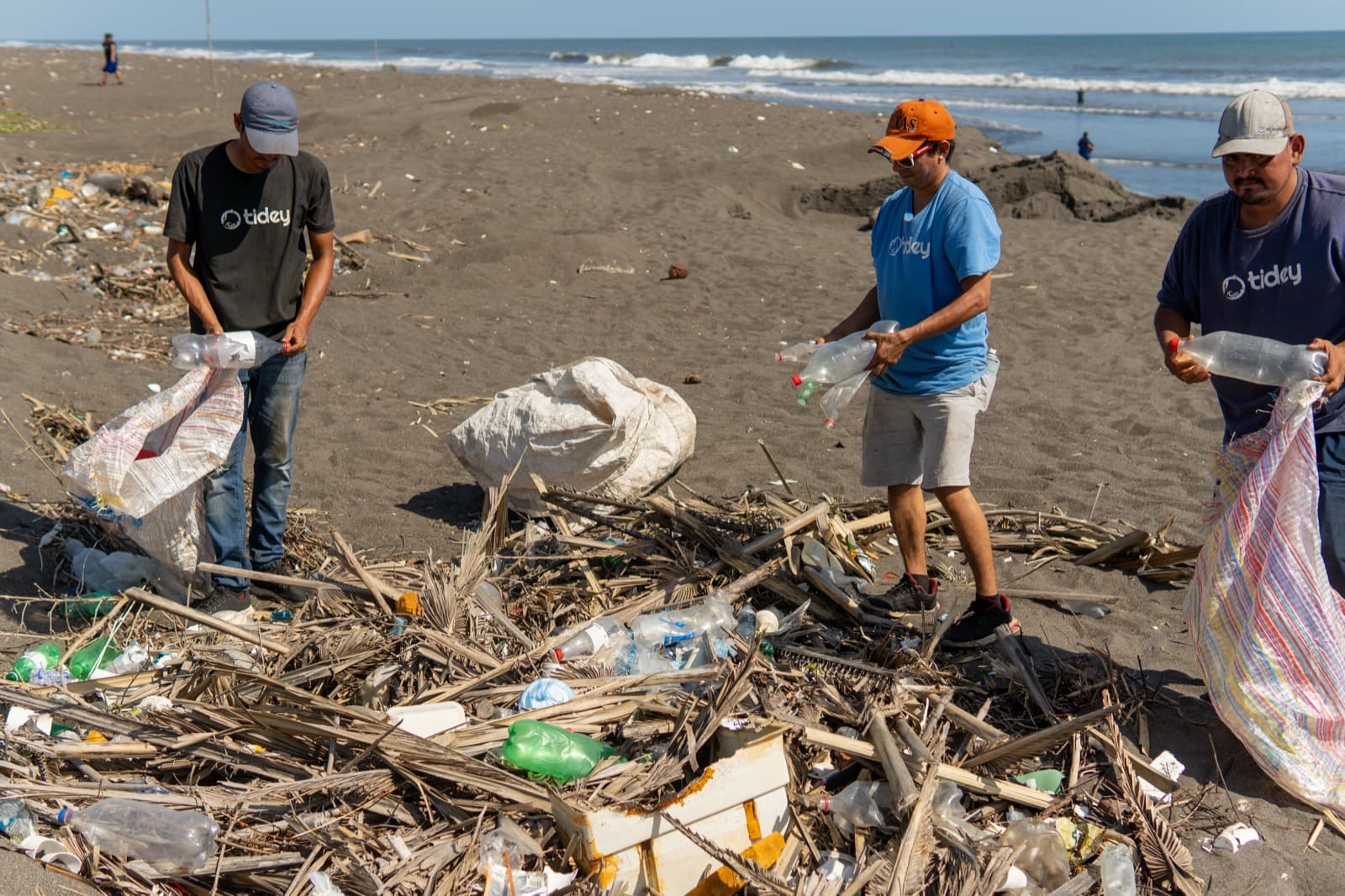
Tidey Ocean operates at this chokepoint. The same modeling work puts the Maria Linda at 1,043,800 kilograms and the adjacent Achiguate at 441,900 kilograms of plastic reaching the Pacific each year, roughly 3.3 million pounds between them. Recovering plastic at the river mouth before it reaches open water means intercepting material that would otherwise disperse, fragment into microplastics under UV exposure, and become effectively unrecoverable. Most collection events are logged on BanQu's blockchain with the collector's name and a timestamp, and with location where it was captured, creating an auditable chain of custody from river bank to recycling facility. A small share of our earlier records carries no attributed name. The numbers in this post are the context for why that work exists. The data does not resolve itself.
Is ocean plastic getting worse?
Yes. The 5 Gyres PLOS ONE study found that the rate of ocean surface plastic accumulation accelerated sharply after 2005 and showed no sign of slowing through 2019. UNEP projects that without major policy changes, annual plastic leakage into aquatic ecosystems could double by 2030. A global treaty on plastic pollution has been under negotiation since 2022 and as of mid-2025 has not produced a binding agreement.
Does recycling solve the problem?
Not at current rates and not at any plausible near-term scale. Even if every country matched the EU's packaging recycling performance, the majority of plastic categories would remain outside the recycling stream. The OECD estimates that with the most ambitious global policy cooperation, the world could reach a recycling rate of around 42 percent by 2040, still leaving more than half of plastic waste going to landfills, incineration, or unmanaged disposal. Source reduction, meaning producing less plastic in the first place, is the variable most researchers identify as necessary to change the baseline.
Is plastic production expected to keep growing?
Based on current projections, yes. UNEP projects that without significant policy intervention, plastic waste entering marine environments could nearly triple by 2060. The global plastics treaty negotiations that stalled in 2025 were the most direct mechanism available for changing that trajectory. What that means for collection programs is that the problem they are addressing is getting larger, not smaller, which is why cost efficiency and verified impact matter more over time, not less.
Are microplastics in drinking water a concern?
Microplastics have been detected in tap water and bottled water across multiple countries. A January 2024 study published in PNAS by researchers at Columbia University and Rutgers University found approximately 240,000 plastic particles per liter in bottled water, far higher than previous estimates, because improved detection technology could identify nanoplastics that earlier methods missed. Bottled water in plastic containers tends to show higher concentrations than tap water in most studies, suggesting the bottle itself contributes to contamination. Point-of-use filters certified to NSF Standard 58, including reverse osmosis systems and certain activated carbon block filters, reduce but do not eliminate microplastic content in drinking water.
Sources
- UNEP. Plastic Pollution and Marine Litter. https://www.unep.org/topics/ocean-seas-and-coasts/ecosystem-degradation-pollution/plastic-pollution-and-marine-litter
- OECD. Global Plastics Outlook: Policy Scenarios to 2060 (2022). https://www.oecd.org/en/publications/global-plastics-outlook_aa1edf33-en/full-report.html
- Meijer, L.J.J. et al. More than 1000 rivers account for 80% of global riverine plastic emissions into the ocean. Science Advances 7, eaaz5803 (2021). https://doi.org/10.1126/sciadv.aaz5803
- The Ocean Cleanup. River plastic emissions source map. https://theoceancleanup.com/sources/
Monthly, from the field in Guatemala.
Collection numbers, new research on plastic and health, and what we are learning in the field. No more than once a month.